 |
Max Sebald at Top Ten Books |
 amazon.com
 amazon.uk
 amazon.ca
 amazon.fr
 amazon.de
 amazon.jp
|
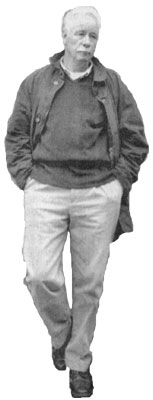 W.G.
(Max) Sebald (1944-2001)
W.G.
(Max) Sebald (1944-2001)
 Three Book Sebald Set: The Emigrants, The Rings of Saturn, and Vertigo -W. G. Sebald - Three Book Sebald Set: The Emigrants, The Rings of Saturn, and Vertigo -W. G. Sebald - The masterworks of W. G. Sebald, now in gorgeous new covers by the famed designer Peter Mendelsund New Directions is delighted to announce beautiful new editions of these three classic Sebald novels, including his two greatest works, The Emigrants and The Rings of Saturn. All three novels are distinguished by their translations, every line of which Sebald himself made pitch-perfect, slaving to carry into English all his essential elements: the shadows, the lambent fallings-back, nineteenth-century Germanic undertones, tragic elegiac notes, and his unique, quiet wit.List Price:$45.95 |
 Austerlitz (Modern Library (Paperback)) -W.G. Sebald - - Modern Library Austerlitz (Modern Library (Paperback)) -W.G. Sebald - - Modern Library This tenth anniversary edition of W. G. Sebald’s celebrated masterpiece includes a new Introduction by acclaimed critic James Wood. Austerlitz is the story of a man’s search for the answer to his life’s central riddle. A small child when he comes to England on a Kindertransport in the summer of 1939, Jacques Austerlitz is told nothing of his real family by the Welsh Methodist minister and his wife who raise him. When he is a much older man, fleeting memories return to him, and obeying an instinct he only dimly understands, Austerlitz follows their trail back to the world he left behind a half century before. There, faced with the void at the heart of twentieth-century Europe, he struggles to rescue his heritage from oblivion. List Price:$18.00 |
 The Rings of Saturn -W. G. Sebald - - New Directions Publishing Corporation The Rings of Saturn -W. G. Sebald - - New Directions Publishing Corporation "The book is like a dream you want to last forever" (Roberta Silman, The New York Times Book Review), now with a gorgeous new cover by the famed designer Peter Mendelsund A masterwork of W. G. Sebald, now with a gorgeous new cover by the famed designer Peter Mendelsund The Rings of Saturn―with its curious archive of photographs―records a walking tour of the eastern coast of England. A few of the things which cross the path and mind of its narrator (who both is and is not Sebald) are lonely eccentrics, Sir Thomas Browne’s skull, a matchstick model of the Temple of Jerusalem, recession-hit seaside towns, wooded hills, Joseph Conrad, Rembrandt’s "Anatomy Lesson," the natural history of the herring, the massive bombings of WWII, the dowager Empress Tzu Hsi, and the silk industry in Norwich. W.G. Sebald’s The Emigrants (New Directions, 1996) was hailed by Susan Sontag as an "astonishing masterpiece perfect while being unlike any book one has ever read." It was "one of the great books of the last few years," noted Michael Ondaatje, who now acclaims The Rings of Saturn "an even more inventive work than its predecessor, The Emigrants."List Price:$16.95 |
 The Emigrants (New Directions Paperbook) -W. G. Sebald - - New Directions Publishing Corporation The Emigrants (New Directions Paperbook) -W. G. Sebald - - New Directions Publishing Corporation A masterwork of W. G. Sebald, now with a gorgeous new cover by the famed designer Peter Mendelsund The four long narratives in The Emigrants appear at first to be the straightforward biographies of four Germans in exile. Sebald reconstructs the lives of a painter, a doctor, an elementary-school teacher, and Great Uncle Ambrose. Following (literally) in their footsteps, the narrator retraces routes of exile which lead from Lithuania to London, from Munich to Manchester, from the South German provinces to Switzerland, France, New York, Constantinople, and Jerusalem. Along with memories, documents, and diaries of the Holocaust, he collects photographs―the enigmatic snapshots which stud The Emigrants and bring to mind family photo albums. Sebald combines precise documentary with fictional motifs, and as he puts the question to realism, the four stories merge into one unfathomable requiem.List Price:$16.95 |
 After Nature (Modern Library (Paperback)) -W.G. Sebald - After Nature, W. G. Sebald’s first literary work, now translated into English by Michael Hamburger, explores the lives of three men connected by their restless questioning of humankind’s place in the natural world. From the efforts of each, “an order arises, in places beautiful and comforting, though more cruel, too, than the previous state of ignorance.” The first figure is the great German Re-naissance painter Matthias Grünewald. The second is the Enlightenment botanist-explorer Georg Steller, who accompanied Bering to the Arctic. The third is the author himself, who describes his wanderings among landscapes scarred by the wrecked certainties of previous ages. After Nature (Modern Library (Paperback)) -W.G. Sebald - After Nature, W. G. Sebald’s first literary work, now translated into English by Michael Hamburger, explores the lives of three men connected by their restless questioning of humankind’s place in the natural world. From the efforts of each, “an order arises, in places beautiful and comforting, though more cruel, too, than the previous state of ignorance.” The first figure is the great German Re-naissance painter Matthias Grünewald. The second is the Enlightenment botanist-explorer Georg Steller, who accompanied Bering to the Arctic. The third is the author himself, who describes his wanderings among landscapes scarred by the wrecked certainties of previous ages.After Nature introduces many of the themes that W. G. Sebald explored in his subsequent books. A haunting vision of the waxing and waning tides of birth and devastation that lie behind and before us, it confirms the author’s position as one of the most profound and original writers of our time. List Price:$18.00 |
 On the Natural History of Destruction (Modern Library Classics (Paperback)) -W.G. Sebald - - Modern Library During World War Two, 131 German cities and towns were targeted by Allied bombs, a good number almost entirely flattened. Six hundred thousand German civilians died—a figure twice that of all American war casualties. Seven and a half million Germans were left homeless. Given the astonishing scope of the devastation, W. G. Sebald asks, why does the subject occupy so little space in Germany’s cultural memory? On the Natural History of Destruction probes deeply into this ominous silence. On the Natural History of Destruction (Modern Library Classics (Paperback)) -W.G. Sebald - - Modern Library During World War Two, 131 German cities and towns were targeted by Allied bombs, a good number almost entirely flattened. Six hundred thousand German civilians died—a figure twice that of all American war casualties. Seven and a half million Germans were left homeless. Given the astonishing scope of the devastation, W. G. Sebald asks, why does the subject occupy so little space in Germany’s cultural memory? On the Natural History of Destruction probes deeply into this ominous silence.List Price:$17.00 |
 Saturn's Moons: A W.G Sebald Handbook -Jo Catling - - Used Book in Good Condition The German novelist, poet and critic W. G. Sebald (1944-2001) has in recent years attracted a phenomenal international following for his evocative prose works such as Die Ausgewanderten (The Emigrants), Die Ringe des Saturn (The Rings of Saturn) and Austerlitz, spellbinding elegiac narratives which, through their deliberate blurring of genre boundaries and provocative use of photography, explore questions of Heimat and exile, memory and loss, history and natural history, art and nature. Saturn's Moons: a W. G. Sebald Handbook brings together in one volume a wealth of new critical and visual material on Sebald's life and works, covering the many facets and phases of his literary and academic careers -- as teacher, as scholar and critic, as colleague and as collaborator on translation. Lavishly illustrated, the Handbook also contains a number of rediscovered short pieces by W. G. Sebald, hitherto unpublished interviews, a catalogue of his library, and selected poems and tributes, as well as extensive primary and secondary bibliographies, details of audiovisual material and interviews, and a chronology of life and works. Drawing on a range of original sources from Sebald's Nachlass -- the most important part of which is now held in the Deutsches Literaturarchiv Marbach - Saturn's Moons will be an invaluable sourcebook for future Sebald studies in English and German alike, complementing and augmenting recent critical works on subjects such as history, memory, modernity, reader response and the visual. Saturn's Moons: A W.G Sebald Handbook -Jo Catling - - Used Book in Good Condition The German novelist, poet and critic W. G. Sebald (1944-2001) has in recent years attracted a phenomenal international following for his evocative prose works such as Die Ausgewanderten (The Emigrants), Die Ringe des Saturn (The Rings of Saturn) and Austerlitz, spellbinding elegiac narratives which, through their deliberate blurring of genre boundaries and provocative use of photography, explore questions of Heimat and exile, memory and loss, history and natural history, art and nature. Saturn's Moons: a W. G. Sebald Handbook brings together in one volume a wealth of new critical and visual material on Sebald's life and works, covering the many facets and phases of his literary and academic careers -- as teacher, as scholar and critic, as colleague and as collaborator on translation. Lavishly illustrated, the Handbook also contains a number of rediscovered short pieces by W. G. Sebald, hitherto unpublished interviews, a catalogue of his library, and selected poems and tributes, as well as extensive primary and secondary bibliographies, details of audiovisual material and interviews, and a chronology of life and works. Drawing on a range of original sources from Sebald's Nachlass -- the most important part of which is now held in the Deutsches Literaturarchiv Marbach - Saturn's Moons will be an invaluable sourcebook for future Sebald studies in English and German alike, complementing and augmenting recent critical works on subjects such as history, memory, modernity, reader response and the visual.The contributors include Mark Anderson, Anthea Bell, Ulrich von Buelow, Jo Catling, Michael Hulse, Florian Radvan, Uwe Schuette, Clive Scott, Richard Sheppard, Gordon Turner, Stephen Watts and Luke Williams. Jo Catling teaches in the School of Literature at the University of East Anglia and Richard Hibbitt in the Department of French at the University of Leeds. List Price:$110.00 |
 A Place in the Country (Modern Library Classics) -W.G. Sebald - A Place in the Country is W. G. Sebald’s meditation on the six artists and writers who shaped his creative mind—and the last of this great writer’s major works to be translated into English. A Place in the Country (Modern Library Classics) -W.G. Sebald - A Place in the Country is W. G. Sebald’s meditation on the six artists and writers who shaped his creative mind—and the last of this great writer’s major works to be translated into English.This edition includes more than 40 pieces of art, all originally selected by W. G. Sebald. This extraordinary collection of interlinked essays about place, memory, and creativity captures the inner worlds of five authors and one painter. In his masterly and mysterious style—part critical essay, part memoir—Sebald weaves their lives and art with his own migrations and rise in the literary world. Here are people gifted with talent and courage yet in some cases cursed by fragile and unstable natures, working in countries inhospitable or even hostile to them. Jean-Jacques Rousseau is conjured on the verge of physical and mental exhaustion, hiding from his detractors on the island of St. Pierre, where two centuries later Sebald took rooms adjacent to his. Eighteenth-century author Johann Peter Hebel is remembered for his exquisite and delicate nature writing, expressing the eternal balance of both the outside world and human emotions. Writer Gottfried Keller, best known for his 1850 novel Green Henry, is praised for his prescient insights into a Germany where “the gap between self-interest and the common good was growing ever wider.” Sebald compassionately re-creates the ordeals of Eduard Mörike, the nineteenth-century German poet beset by mood swings, depression, and fainting spells in an increasingly shallow society, and Robert Walser, the institutionalized author whose nearly indecipherable scrawls seemed an attempt to “duck down below the level of language and obliterate himself” (and whose physical appearance and year of death mirrored those of Sebald’s grandfather). Finally, Sebald spies a cognizance of death’s inevitability in painter Jan Peter Tripp’s lovingly exact reproductions of life. Featuring the same kinds of suggestive and unexplained illustrations that appear in his masterworks Austerlitz and The Rings of Saturn, and translated by Sebald’s colleague Jo Catling, A Place in the Country is Sebald’s unforgettable self-portrait as seen through the experiences of others, a glimpse of his own ghosts alongside those of the men who influenced him. It is an essential addition to his stunning body of work. Praise for A Place in the Country “Measured, solemn, sardonic . . . hypnotic . . . [W. G. Sebald’s] books, which he made out of classics, remain classics for now.”—Joshua Cohen, The New York Times Book Review “In Sebald’s writing, everything is connected, everything webbed together by the unseen threads of history, or chance, or fate, or death. The scholarly craft of gathering scattered sources and weaving them into a coherent whole is transformed here into something beautiful and unsettling, elevated into an art of the uncanny—an art that was, in the end, Sebald’s strange and inscrutable gift.”—Slate “Magnificent . . . The multiple layers surrounding each essay are seamless to the point of imperceptibility.”—New York Daily News “Sebald’s most tender and jovial book.”—The Nation “Reading [A Place in the Country is] like going for a walk with a beautifully talented, deeply passionate novelist from Mars.”—New York List Price:$20.00 |
 Vertigo -W. G. Sebald - - New Directions Publishing Corporation Vertigo -W. G. Sebald - - New Directions Publishing Corporation A masterwork of W. G. Sebald, now with a gorgeous new cover by the famed designer Peter Mendelsund Perfectly titled, Vertigo ―W.G. Sebald's marvelous first novel ― is a work that teeters on the edge: compelling, puzzling, and deeply unsettling. An unnamed narrator, beset by nervous ailments, journeys accross Europe to Vienna, Venice, Verona, Riva, and finally to his childhood home in a small Bavarian village. He is also journeying into the past. Traveling in the footsteps of Stendhal, Casanova, and Kafka, the narrator draws the reader, line by line, into a dizzying web of history, biography, legends, literature, and ― most perilously ― memories. List Price:$16.95 |
 W.G. Sebald (Writers and Their Work) -Uwe Schütte - W. G. Sebald was a literary phenomenon: a German literary scholar working in England, who took up creative writing out of dissatisfaction with German post-war letters. Within only a few years, his unique prose books made him one of the most celebrated authors of the late twentieth-century. Sebald died prematurely, aged 57, after the publication of his most celebrated prose fiction Austerlitz. This accessible critical introduction, written by a leading expert, highlights Sebald's double role as writer and academic. It discusses his oeuvre in the order in which his works were published in German in order to offer a deeper understanding of the original development of his literary writings. In addition to concise but incisive interpretations of the main publications, Schütte demonstrates how Sebald's critical writings (most of which still await translation) fed into his literary texts and concludes his study with a perceptive assessment of Sebald as a cult author. W.G. Sebald (Writers and Their Work) -Uwe Schütte - W. G. Sebald was a literary phenomenon: a German literary scholar working in England, who took up creative writing out of dissatisfaction with German post-war letters. Within only a few years, his unique prose books made him one of the most celebrated authors of the late twentieth-century. Sebald died prematurely, aged 57, after the publication of his most celebrated prose fiction Austerlitz. This accessible critical introduction, written by a leading expert, highlights Sebald's double role as writer and academic. It discusses his oeuvre in the order in which his works were published in German in order to offer a deeper understanding of the original development of his literary writings. In addition to concise but incisive interpretations of the main publications, Schütte demonstrates how Sebald's critical writings (most of which still await translation) fed into his literary texts and concludes his study with a perceptive assessment of Sebald as a cult author.List Price:$29.95 |
Home • Books • DVD! • CoolStuff • Computer Sales • Music • Furniture • Kids' Stuff • Video • Software • Clothing • Tools • Cookware • Gourmet Foods • Housewares • Jewelry • Sporting Goods • Outdoor Store • Health and Personal Care • Home Theater • Musical Instruments

©1999-2008 Ardan Scientific Programming, L.L.C.